
Written by Dr. Jon Vezendy, D.C., of Vezendy Chiropractic in Cornelius, NC. Updated November 2026.
Quick answer
All three stretch your spine to take pressure off the discs and nerves. Regular traction uses weights or a machine to pull. Spinal decompression is traction run by a computer that slowly pulls, then relaxes, over and over. An inversion table uses gravity while you tilt back at home, and it isn’t safe for everyone.
At a glance
Traction: Weights, pulleys or a machine gently pull on your spine to make a little more room between the bones.
Spinal decompression: A type of traction on a computer-controlled table. It slowly stretches your spine, lets it relax, and repeats.
Inversion table: A home device you strap into and tip back on, so gravity does the pulling.
If you’ve been told you have a disc problem, you’ve probably heard all three of these names. They sound alike for a good reason. Each one stretches the spine. What changes is how the pull is controlled, where it happens, and who should skip it.
Is spinal decompression the same as traction?
Spinal decompression is a kind of traction, so the two are close relatives. Both gently pull on your spine to make a little more space between the bones and ease pressure on the discs and nerves.
The difference is how the pull is controlled. With regular traction, weights, pulleys or a motor pull with the force that’s been set. A decompression table runs on a computer. It slowly builds the stretch, eases off, and then stretches again for the whole session. The idea behind that slow, on-and-off pull is to keep the muscles around your spine from tightening up against it.
Studies that compare the two side by side have been small. In one, 31 people with herniated discs all did the same core exercises. About half also had decompression, and the rest had regular traction. After three weeks, the decompression group came out ahead on MRI measures of the disc, though the study was small and done at one hospital. Results vary from person to person.
How is an inversion table different?
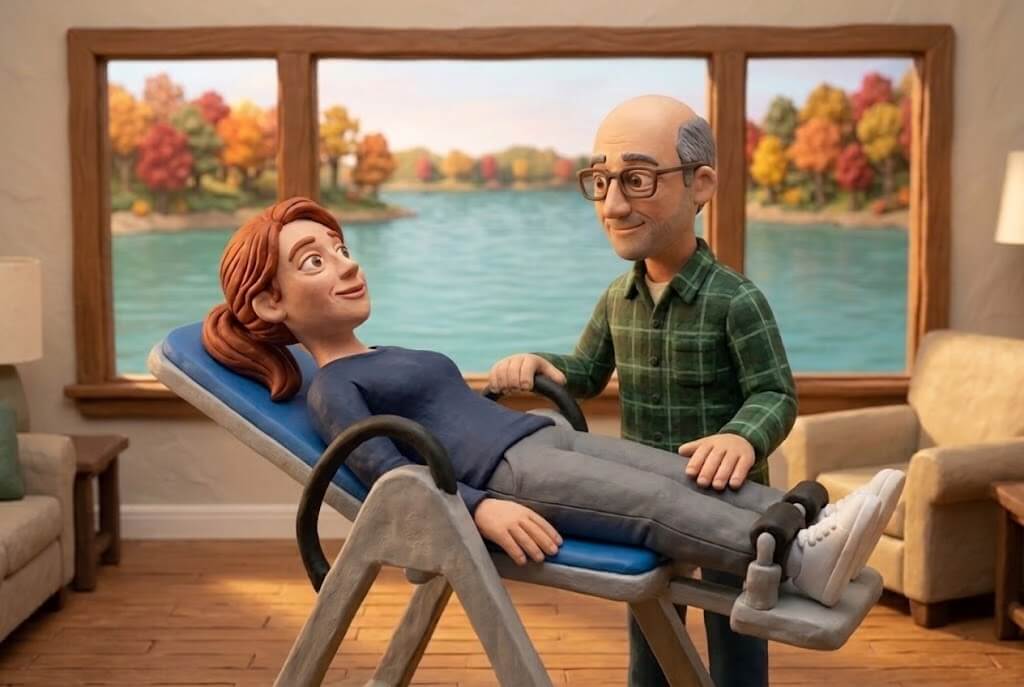
An inversion table is traction you do at home, with gravity doing the work instead of a machine. You strap in, lie back, and tip backward anywhere from a slight angle to fully upside down. You decide how far you go and how long you stay.
Some people feel short-term relief from inverting. The research is mixed, though. Some studies found it helped some people, and others found no benefit at all.
Safety is the bigger question. Hanging head-down sends more blood toward your head and raises the pressure inside it. Talk to your doctor before you try an inversion table if you have, or are at high risk for, any of these:
- High or low blood pressure
- Heart disease or another heart condition
- Glaucoma or another eye disease
- Acid reflux
- Pregnancy
- A past stroke or brain injury
Which one makes sense for your back?
That depends on what’s causing your pain, and that’s why an exam comes first. A bulging disc, a pinched nerve, sciatica and spinal stenosis can feel a lot alike, but they don’t always need the same care.
At our Cornelius office, we don’t rely on just one kind of stretch. We have a spinal decompression table, a Cox flexion-distraction table, and intersegmental traction, which gently moves each joint in your spine. After your exam, the doctor picks what fits your back, or tells you if none of them is a good fit. You can read more about how spinal decompression works at our office. If you’re wondering whether you’d be a candidate, our decompression checklist walks through who it’s for and who should skip it.
Quick answers
Will an inversion table do the same thing as spinal decompression?
Not quite. Both stretch your spine, but an inversion table uses gravity and you set the angle yourself. A decompression table is computer-controlled and used in the office. An inversion table also isn’t safe for some people, including those with high blood pressure, heart disease or glaucoma.
Can I do spinal decompression at home?
You can stretch your spine at home with something like an inversion table, but that isn’t the same as a decompression table. If you want to try one, check with your doctor first. Start with short sessions of under a minute, come back up slowly, and have someone nearby the first time.
Do doctors still use traction for back pain?
Yes. Traction is still one of the non-surgical options for disc and nerve pain, and chiropractors and physical therapists use it. Whether it’s right for you depends on what’s behind your pain.
Not sure which one fits your back?
Vezendy Chiropractic in Cornelius can examine your back and tell you which option makes sense for you, if any. We aim for same-day or same-week availability. Request an appointment or call (704) 895-2240.
Sources: Cleveland Clinic, “Spinal Decompression Therapy” (my.clevelandclinic.org/health/treatments/10874-spinal-decompression-therapy) and “Inversion Tables Might Flip the Script on Back Pain” (health.clevelandclinic.org/can-inversion-tables-really-relieve-back-pain).
Study: Kang JI, Jeong DK, Choi H. “Effect of spinal decompression on the lumbar muscle activity and disk height in patients with herniated intervertebral disk.” Journal of Physical Therapy Science, 2016 (pmc.ncbi.nlm.nih.gov/articles/PMC5140813).
This information is intended for educational purposes only and is not meant to substitute for medical care or to prescribe treatment for any specific health condition.